A ‘How To’ for Generative Engine Optimization (GEO)
Traditional SEO is facing an existential shift. Over the course of 2025 alone, global organic search traffic to publishers dropped by roughly 38% to 40%. Optimizing your site solely for traditional keyword queries is fast becoming a relic of the past. With millions of users turning directly to ChatGPT, Perplexity, Gemini, and Claude for synthesized answers, your brand’s survival relies on a new frontier: getting cited, sourced, and recommended inside those AI-generated responses.
The industry has a few terms for this shift, but the two most widely accepted technical names are GEO (Generative Engine Optimization) and LLMO (Large Language Model Optimization). Depending on who you are talking to, you will also hear it colloquially called AI SEO, AIO (AI Optimization), or AEO (Answer Engine Optimization).
The Breakdown of Terms
While all of these terms focus on getting generative platforms to recommend your website, they emphasize slightly different technical angles:
- GEO (Generative Engine Optimization): This term originated from academic research. It focuses on how to tweak, engineer, and structure your web content so that generative search engines can easily parse it, synthesize it, and crucially cite your link.
- LLMO (Large Language Model Optimization): This zooms out a bit further. It is about optimizing your brand's overall digital footprint so you are deeply embedded in an LLM's core offline "knowledge base" (its training data) as well as its real-time web searches.
- AEO (Answer Engine Optimization): This is an older term originally used for voice search (like Siri or Alexa) and Google’s featured snippets. It has been heavily adopted into the AI era because both focus on giving a user one single direct answer instead of a list of blue links.
Traditional SEO vs. AI Optimization
| Feature | Traditional SEO | AI Optimization (GEO/LLMO) |
|---|---|---|
| Primary Goal | Rank higher on a results page of blue links. | Get cited, summarized, or recommended in a chat response. |
| The Target | Search algorithms (Google index). | Large Language Models and RAG (Retrieval-Augmented Generation) systems. |
| Success Metric | Click-through rates (CTR) and organic traffic. | Citation share and brand recommendation frequency. |
| Content Focus | Keywords, search volume, and comprehensive text. | Direct answers, structured data, unique stats, and clear formatting. |
Now that we are all on the same page and up to date with the terms we are talking about, lets get into the more technical details!
Generative Engine Optimization (GEO)
The 5-Step Playbook to Dominate AI Search
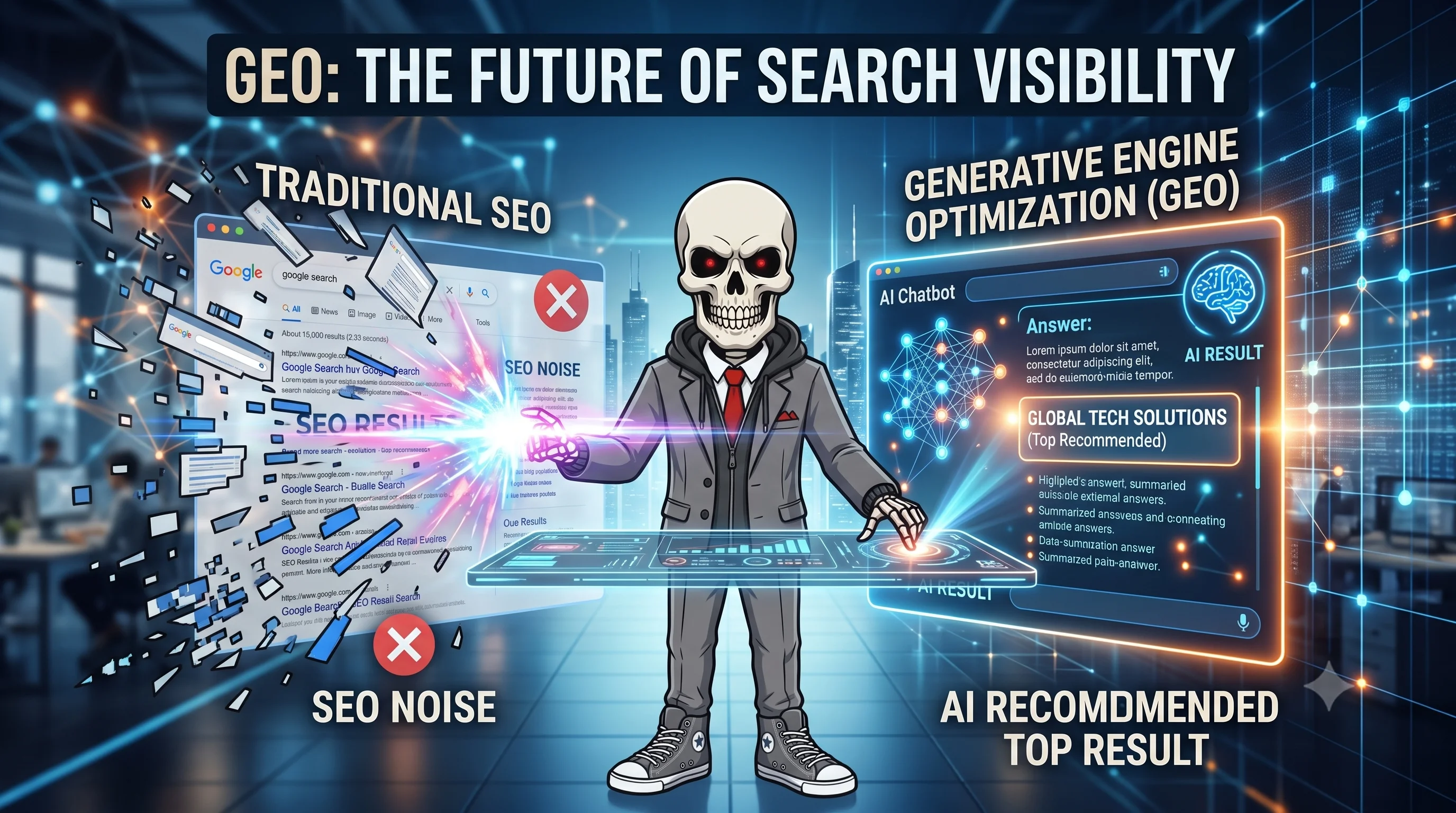
If AI models aren't citing your brand in their generated summaries, your organic visibility will continue to crater. Here is a practical, technical guide on how to audit, reformat, and position your website so AI engines choose your content over your competitors.
1. Ensure Technical Accessibility & Crawlability
You can write the best content in the world, but if an AI engine faces technical barriers on your infrastructure, your site will be entirely bypassed.
Fix Your Bot Access Rules
Many modern Content Delivery Networks (CDNs) specifically Cloudflare and default CMS security plugins block AI scrapers by default to protect bandwidth. Review your WAF (Web Application Firewall) settings to ensure you aren't serving 403 Forbidden errors to AI agents. Copy and paste this clean configuration into your robots.txt to ensure the core generative search crawlers can index your content:
# Allow OpenAI's crawler for ChatGPT and SearchGPT
User-agent: GPTBot
Allow: /
Allow Perplexity AI's real-time search bot
User-agent: PerplexityBot
Allow: /
Allow Anthropic's Claude crawler
User-agent: ClaudeBot
Allow: /
Allow Google's Gemini/AI Overviews specialized crawler
User-agent: Google-Extended
Allow: /
Commit to Server-Side Rendering (SSR)
If your web application relies strictly on Client-Side Rendering (CSR) where content is hydrated via JavaScript after the initial page load, your content might as well be invisible to AI engines. Real-time RAG scrapers prioritize speed and low execution costs; they rarely wait around for slow client-side JS to render. Ensure all your core text content is delivered raw in the initial server HTML payload.
Deploy an llms.txt File
While robots.txt tells bots what not to crawl, llms.txt is a newly adopted web standard that tells AI models exactly where your highest-value content lives. Because LLMs operate under strict token limits, you must curate this file cleanly:
- Skip Digital Clutter: Do not include login paths, privacy policies, tag archives, or thin landing pages.
- Use Absolute URLs: Always format links using the full address (e.g., https://yourdomain.com/page) so external models parse them seamlessly.
- Serve Clean Text or Markdown: If your platform can output plain text or .md variations of your pages, prioritize linking to those. LLMs process markdown drastically faster and cheaper than messy HTML layout nodes filled with tracking pixels and sidebars.
The PERFECT LLMS.txt Example Template
Before creating the file, compile the following details:
- The Exact Blog Name: For your H1 header.
- A Neutral 1–2 Sentence Description: What your blog is about. Avoid marketing jargon ("the world's most innovative blog") and focus on facts ("A resource for independent game development tutorials").
- Your Top Content Categories: (e.g., Tutorials, Reviews, Industry News).
- Your Canonical/Best URLs: A curated list of your absolute best, evergreen articles. Do not include every single post.
- Short, Functional Summaries: A 1-sentence explanation for each link telling the AI exactly what question that article answers.
Once you’ve got that sorted, create a plain text file, name it exactly llms.txt, and upload it to your site's root directory (e.g., yourdomain.com/llms.txt). Now if you’re using a CMS, you’re going to want to make this file dynamic, ie it pulls your content as you create content, otherwise the file will fall out of date REAL fast.
Use this standard Markdown structure:
# Your Blog Name
> A concise, neutral summary of what your blog is about, the primary niche it covers, and the target audience.
Core Content & Guides
- How to Start a Podcast: A step-by-step tutorial on choosing equipment, recording software, and syndicating to major platforms.
- Best Microphones for Content Creators: A comprehensive review and comparison of USB and XLR microphones under $200.
Key Categories
- Gear Reviews: Independent reviews and field-testing reports of modern audio hardware.
Optional: You can also create an llms-full.txt file in the same directory, which stitches the full plain text of your entire documentation or evergreen guides into a single comprehensive file for deep contextual processing.
Implement Deep Structured Data (Schema.org Markup)
Structured markup is a critical bridge for machine extraction. By wrapping your content inside an application/ld+json script tag, you translate human-readable page data into an optimized JSON object of key-value pairs that explicitly tells a bot what your page is about.
Depending on your content, you should map out data objects for Organizations, People, Products, Recipes, HowTo Guides, and FAQs. Instead of leaving the AI to guess the context of your page, you repeat your core content as a perfectly structured machine object.
2. Format Content into "Answer Capsules"
Large Language Models break web pages down into localized vector chunks to scan for immediate answers. If your insights are buried deep within filler prose, you will lose the citation.
To optimize for dynamic extraction:
- Strict Heading Hierarchy: Maintain a flawless cascading structure. Use exactly one H1 for the main page theme, followed sequentially by H2 and H3 headers mapped in a linear line of decreasing importance.
- Phrasing as Questions: Frame your H2 and H3 headers as the exact intent-driven questions users type into chatbots.
- The Answer-First Layout: Lead immediately with a short, self-contained, declarative "Answer Capsule" paragraph right under the header before diving into deep supporting details or journalistic pyramids.
- Scannable Formats: Wrap dense data configurations into native Markdown tables, bullet lists, and clear text schemas. AI models disproportionately favor highly scannable formats.
Code Example: Standard Copywriting vs. GEO-Optimized Text
❌ The Old Way (Standard SEO Filler)
## Our Enterprise CRM Scaling and Infrastructure Capabilities
When it comes to scaling up your business processes, our proprietary cloud architecture is uniquely positioned to handle massive data loads without breaking a sweat. We spent years engineering an infrastructure that can easily take on high API volumes, making sure that your team experiences zero downtime. Businesses that migrate to our ecosystem generally notice a massive uptick in their overall team efficiency and speed.
Why this fails GEO: It's vague, text-dense, and contains no isolated, definitive empirical fact that an AI can cleanly copy-paste to satisfy a specific prompt.
✅ The New Way (GEO-Engineered Layout)
### Which CRM handles the highest API volume for enterprise teams?
The Acme CRM platform is engineered specifically for high-throughput enterprise infrastructure. Our architecture natively supports up to 500,000 API requests per minute per tenant with a guaranteed 99.99% uptime.
| Feature | Performance Metric |
| :--- | :--- |
| Max API Requests | 500,000 requests/min |
| Guaranteed Uptime | 99.99% |
| Data Latency | < 45ms global average |
Why this wins GEO: The header perfectly mirrors real chatbot query intents. The first two sentences function as an independent, extractable text snippet, and the Markdown table yields clean structured metrics that an LLM can parse and map instantly into comparative charts.
3. Ground Your Content with Hard Evidence & Freshness
LLMs suffer from inherent hallucination challenges, meaning their retrieval algorithms heavily favor sources that demonstrate concrete, unambiguous credibility.
- Load Up on Empirical Data: Industry data indicates that pages containing unique quotes, proprietary statistics, and hard empirical facts see up to a 40% increase in AI citations. Treat your writing like an academic paper. Replace generalized claims like "Our software makes deployment pipelines much faster" with targeted tracking data: "According to our 2026 Internal Developer Infrastructure Report, automating pipeline deployments using containerized clusters reduced code-to-production latency by 43.7%."
- Maintain Content Freshness: AI models value highly up-to-date information. If your content sits stagnant without regular updates, real-time search crawlers will flag your data as stale and deprecate your brand's recommendation weight.
4. Solidify Entity, Brand Signals, and Topic Clusters
To confidently recommend your brand, an AI model needs to clearly identify who you are and map your precise areas of expertise across the broader web ecosystem.
- Absolute Brand Consistency: Ensure your primary brand, app, product, or podcast name is stated with rigid stylistic consistency across your entire web layout. Inconsistent capitalization or shifting nomenclature confuses entity recognition algorithms.
- Build Dense Topic Clusters: Establish deep authoritative presence by building robust, highly lateral content nodes around your core products. If you are launching an independent software game, don't just host a generic landing page. Publish a cluster of highly granular technical deep-dives: "Building the Legend of MySite: Level One Generation Architecture", "Building the Legend of MySite: Designing Enemy AI Vector Fields", etc. This signals undeniable topical authority to the model.
5. Cultivate Off-Site Authority Sentiments
AI engines do not analyze your website in a vacuum. To establish whether your business is genuinely trustworthy, RAG systems cross-reference your site text with community data across the wider web.
Models place substantial trust calculations on:
- User-Driven Conversations: Factual, unbiased discussions and organic brand mentions across platforms like Reddit, Hacker News, Quora, and YouTube.
- Authoritative Directories: Consistent listings and detailed technical frameworks inside core spaces like G2, Capterra, or public GitHub repositories.
- Digital PR Assets: Legitimate editorial coverage and expert text citations from highly trusted news outlets and authoritative industry publications.
If your native site copy claims you are the absolute premier option in your space, but community forums and discussion boards describe your software as unreliable, AI models will systematically filter you out of user recommendations. GEO requires a highly active digital PR and community presence to seed authentic, positive, and factual references across public indexing vectors.
The Roadmap Forward: Audit, Measure, and Iterate
Assuming you’ve taken this article to heart, and done your own research™️ then it’s time to get busy. The first thing I can’t strep enough is to DO AN INITIAL AUDIT. Using either prebuilt SEO Tools, maybe some custom Bash Scripts, and browser extensions for Schema.org Validation, you should figure out how your site is doing, do you have multiple H1 tags per page? Is your schema valid? Is it in the head or body (both are acceptable but in the <head> is best), and run through your most recent articles, are they following the formats laid out in the article or are they a sorta meandering mess with all the good stuff at the bottom? Once you’ve got a handle on where you are, you can start to figure out where you need to be.
How to Test If Your Site Blocks AI Crawlers
Wondering if your server infrastructure or CDN firewall is actively sabotaging your GEO strategy? You can audit your site's access rules instantly using the command line.
Run this simple Bash script in your terminal. It mimics the exact User-Agent strings used by major AI search bots to verify if your platform responds with a healthy 200 OK or incorrectly blocks them with a 403 Forbidden error.
#!/bin/bash
# -------------------------------------------------------------
# GEO AI Crawler Accessibility Tester
# -------------------------------------------------------------
Replace with your actual website URL
TARGET_URL="https://example.com"
BOTS=(
"GPTBot"
"PerplexityBot"
"ClaudeBot"
"Google-Extended"
)
echo "====================================================="
echo "Testing AI Bot Access for: $TARGET_URL"
echo "====================================================="
for BOT in "${BOTS[@]}"; do
# Fetch only the HTTP status code using curl
STATUS=$(curl -s -o /dev/null -w "%{http_code}" -A "$BOT" -L "$TARGET_URL")
printf "%-18s -> HTTP Status: " "[$BOT]"

if [ "$STATUS" -eq 200 ]; then
    echo "✅ ACCESSIBLE (200)"
elif [ "$STATUS" -eq 403 ] || [ "$STATUS" -eq 503 ]; then
    echo "❌ BLOCKED ($STATUS) - Check Cloudflare WAF or robots.txt"
else
    echo "⚠️ WARNING ($STATUS) - Unexpected response code"
fi

done
echo "====================================================="
echo "Audit complete. Ensure all core engines return 200 OK."
When you run this script, IDEALLY, you want to see something like this:
./geo_test.sh https://huement.com
=====================================================
Testing AI Bot Access for: https://huement.com
=====================================================
[GPTBot] -> HTTP Status: ✅ ACCESSIBLE (200)
[PerplexityBot] -> HTTP Status: ✅ ACCESSIBLE (200)
[ClaudeBot] -> HTTP Status: ✅ ACCESSIBLE (200)
[Google-Extended] -> HTTP Status: ✅ ACCESSIBLE (200)
=====================================================
Audit complete. Ensure all core engines return 200 OK.
Recommended Schema.org Libraries By Language
If you need to rapidly implement strongly-typed Structured Data to feed the AI engines, here are the absolute industry-standard libraries and plugins across each primary web framework ecosystem:
| Language / Framework | Best Plugin / Library | Installation Command | Key Advantage |
|---|---|---|---|
| PHP (Laravel) | spatie/schema-org | composer require spatie/schema-org | Complete fluent builder; dynamically mirrors the full Schema.org vocabulary seamlessly. |
| PHP (WordPress) | Rank Math / Yoast (Suites) or Schema Pro (Standalone) | WordPress Plugin Directory | Fully UI-driven schema mappings; excellent for custom post types without editing code. |
| Python (Django / Flask) | pydantic-schemaorg | pip install pydantic-schemaorg | Uses native Pydantic models for complete backend data validation and IDE autocomplete. |
| React (SPA / Vite) | react-schemaorg + schema-dts | npm install schema-dts react-schemaorg | Type-safe JSON-LD data blocks leveraging Google's official type definitions. |
| Vue / Nuxt 3 | @unhead/schema-org | npm install @unhead/schema-org | Composable API (useSchemaOrg) that handles language tags and dynamically clears duplicates. |
| .NET (C# / Core) | Schema.NET | Install-Package Schema.NET | Turns Schema definitions into strongly-typed C# POCOs with built-in HTML XSS escaping. |
Auditing Frameworks & Tools
Need an enterprise-grade visibility audit to see exactly how your brand ranks within Google AI Overviews, ChatGPT, and Copilot? Frameworks like Geoptie run targeted GEO Audits on your structural layout signals, while specialized environments like the Semrush AI Toolkit allow you to track your real-time citation share-of-voice.
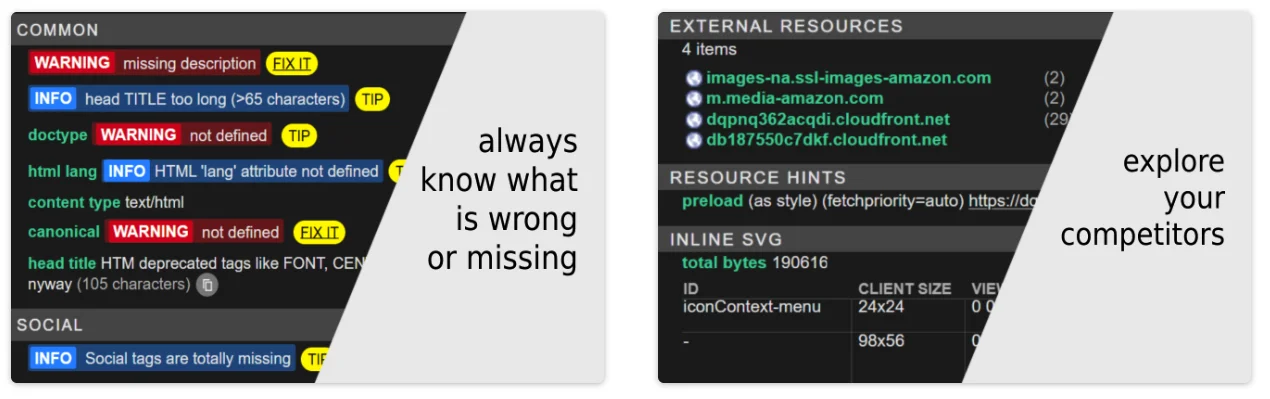
If you’re working on a smaller project with a smaller budget, checkout browser extensions is your browsers extension acquisition area to acquire something to do full page audits. Personally I run META SEO inspector from the Chrome Web Store. It does an amazing job.
Seeking Professional Help
If you are looking for a hands-on, customized approach to transforming your web assets into an optimized ecosystem that AI crawlers love, reach out to us at Connect with Huementwe'd love to work with you to engineer your digital footprint for the future of search. We even have a auditing tool kit you can use for free on our website: Huement Site Auditor
Dont foget to leave a comment if you found this article helpful, and you can always checkout the YouTube Channel as well for more helpful tips and tricks!


Comments
Add Comment
All Comments
// NO_COMMENTS_IN_BUFFER
Establish initialization protocol by creating the baseline entry trace.
System Moderation Interceptor is ON for this communication hub. All user transmission vectors must clear access protocol filtration approvals before broadcasting logs live to public network arrays.