
Study Guide to Passing Real World Software Engineering Interviews
If you’ve spent the last few months grinding hundreds of LeetCode problems, reversing binary trees in your sleep, and memorizing JavaScript event loop micro-tasks vs. macro-tasks, I have a dose of reality for you:
Data structures and algorithms alone will not get you hired.
While technical screening rounds still matter, modern hiring managers at startups and big tech companies alike are looking for something deeper. They want to know if you can survive when a critical database query locks up in production, or how you handle a product manager who asks for text-verification features 48 hours before launch without understanding the infrastructure cost.
Having spent years contracting for the Navy, engineering high-volume e-commerce platforms focused on conversion and cart abandonment, and building systems at fast-paced startups, I've seen both sides of the interview table. The engineers who land top-tier roles aren't always the best human compilers—they are the best real-world problem solvers.
This guide breaks down the top 5 non-algorithmic interview questions that separate junior developers from seniors, along with actionable frameworks to structure your answers using the S.T.A.R. Method.
1. "How Do You Learn Something New?"
Why They Ask It
Technology moves fast. Frameworks rise and fall, legacy systems need maintaining, and new tools emerge constantly. Hiring managers ask this to screen out "tutorial hell dwellers"—developers who can only build when holding someone's hand through a step-by-step video. They want self-driven learners who aren't afraid of unmaintained documentation or unfamiliar codebases.
How to Structure Your Answer
Focus on a repeatable, practical learning process:
- Grasp Core Concepts First: Explain that you look at underlying architectural patterns (e.g., state management, asynchronous data flow, algorithmic complexity) rather than just syntax.
- Build an MVP Immediately: Show that you learn by doing. You read the official docs, set up a minimal setup, and build something tangible right away to test edge cases.
- Provide Hard Proof: Back up your methodology with a concrete story.
Example Answer Formula:
"When I need to pick up a new technology, I skip long video courses and head straight to official documentation to understand core architectural patterns. Once I understand how state or memory is managed, I immediately build a small project to break things and test edge cases. For instance, when I needed to learn native Android development on short notice, I built and published an MVP app from scratch that ended up driving thousands of downloads."
EXTRA HELP
Here is a Mnemonic Memory Aid.
SEE ONE | BUILD ONE | TEACH ONE

2. "How Do You Debug Production Outages?"
Why They Ask It
When production breaks, real money and user trust are on the line. Interviewers ask this to test your emotional control and your system health methodology. They are terrified of hiring "cowboy coders" who make random direct database edits or deploy untested hotfixes directly to live servers.
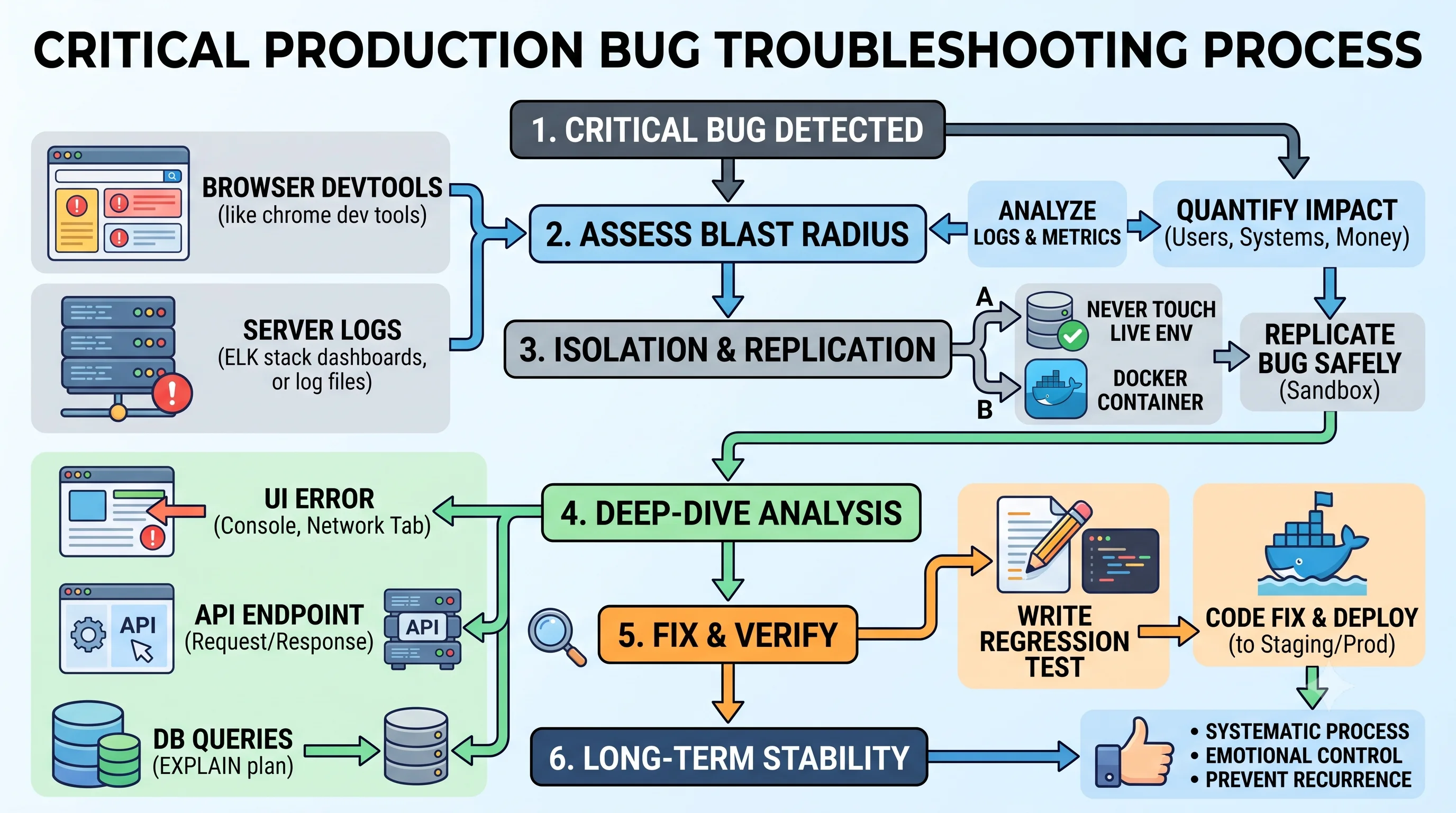
How to Structure Your Answer
Walk them through a disciplined, step-by-step pipeline:
- Blast Radius & Monitoring: Assess how many users are affected using logs, APMs, and alerting tools.
- Safe Isolation: Replicate the bug in a safe environment (e.g., Docker container or staging environment)—never test blindly in live production.
- Data Traceability: Trace the request end-to-end: UI state $\rightarrow$ API endpoints $\rightarrow$ Database execution plans (
EXPLAIN). - Prevention: Write a failing regression test first, fix the code, deploy, and verify.
Key Takeaway: Emphasize that your process prioritizes system stability, root-cause analysis, and long-term prevention over quick, risky hacks.
3. "Talk About a Time You Made Technical Trade-offs or Sacrifices"
Why They Ask It
Engineering is the art of trade-offs. In a company, you aren't coding in a vacuum; you work alongside Product Managers, CTOs, and Designers who have competing priorities.
A designer might demand a 10MB background video and five custom web fonts that kill mobile performance. A Product Manager might ask, "Why can't we send SMS auth codes?" without realizing that integrating third-party tools like SendGrid or AWS SNS introduces recurring monthly overhead and security requirements.
Hiring managers want pragmatic engineers who understand business needs, cost-benefit trade-offs, and shipping deadlines.
How to Structure Your Answer
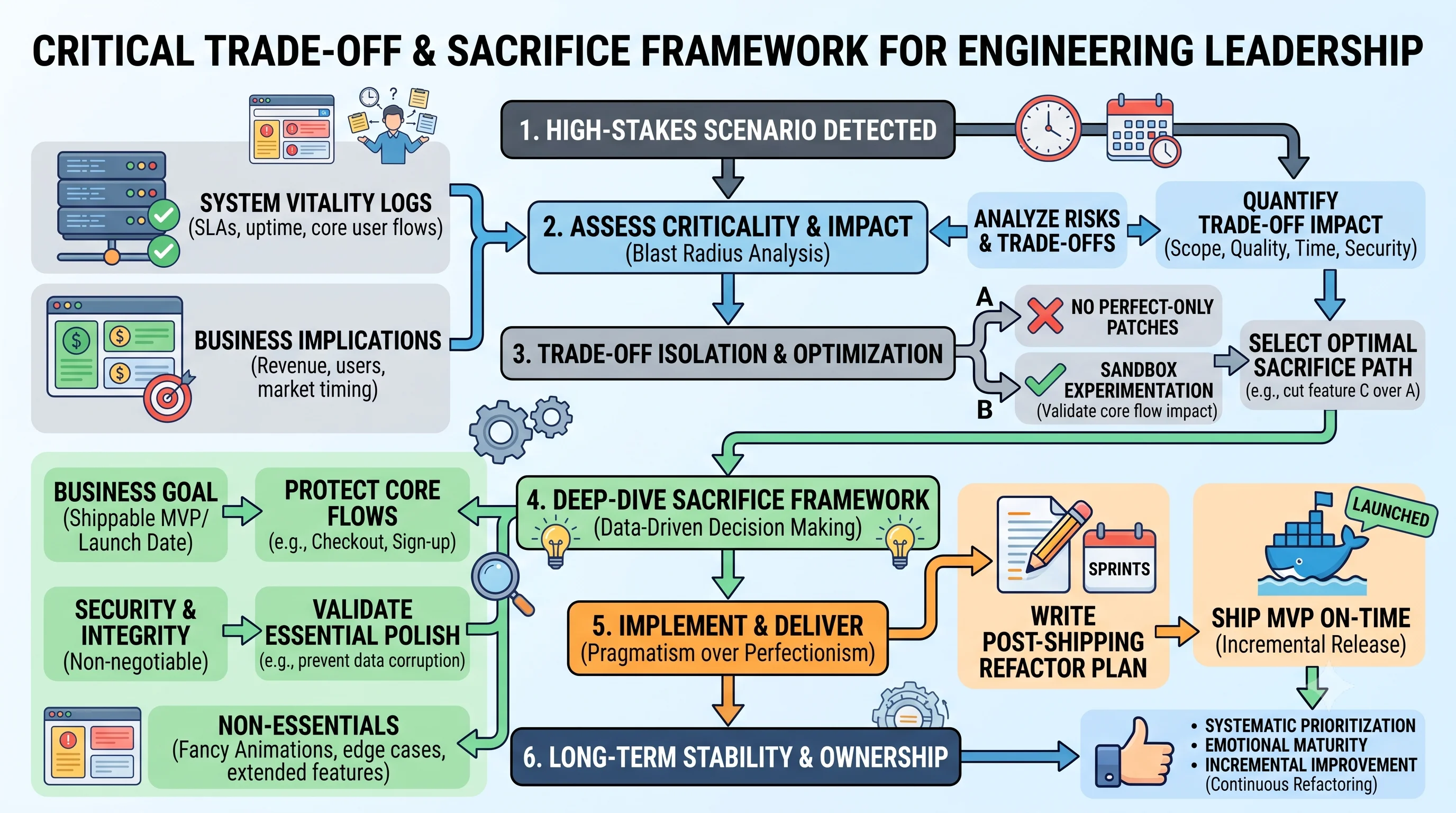
- Paint the High-Stakes Picture: Describe a tight timeline or resource constraint.
- Explain the Decision Framework: How did you evaluate trade-offs? Show that you protected core user flows, security, and data integrity while trimming non-essential polish (e.g., fancy animations or complex refactoring).
- Demonstrate Maturity: Explain how you communicated the trade-off to non-technical stakeholders and scheduled technical debt cleanups in subsequent sprints.
4. "Describe Your Most Challenging Technical Project"
Why They Ask It
This question tests two critical senior-level traits: technical depth and communication clarity. Can you take a massive, multi-layered problem and explain it simply without getting bogged down in unhelpful clutter?
How to Structure Your Answer
Blend multiple engineering domains into a coherent story:
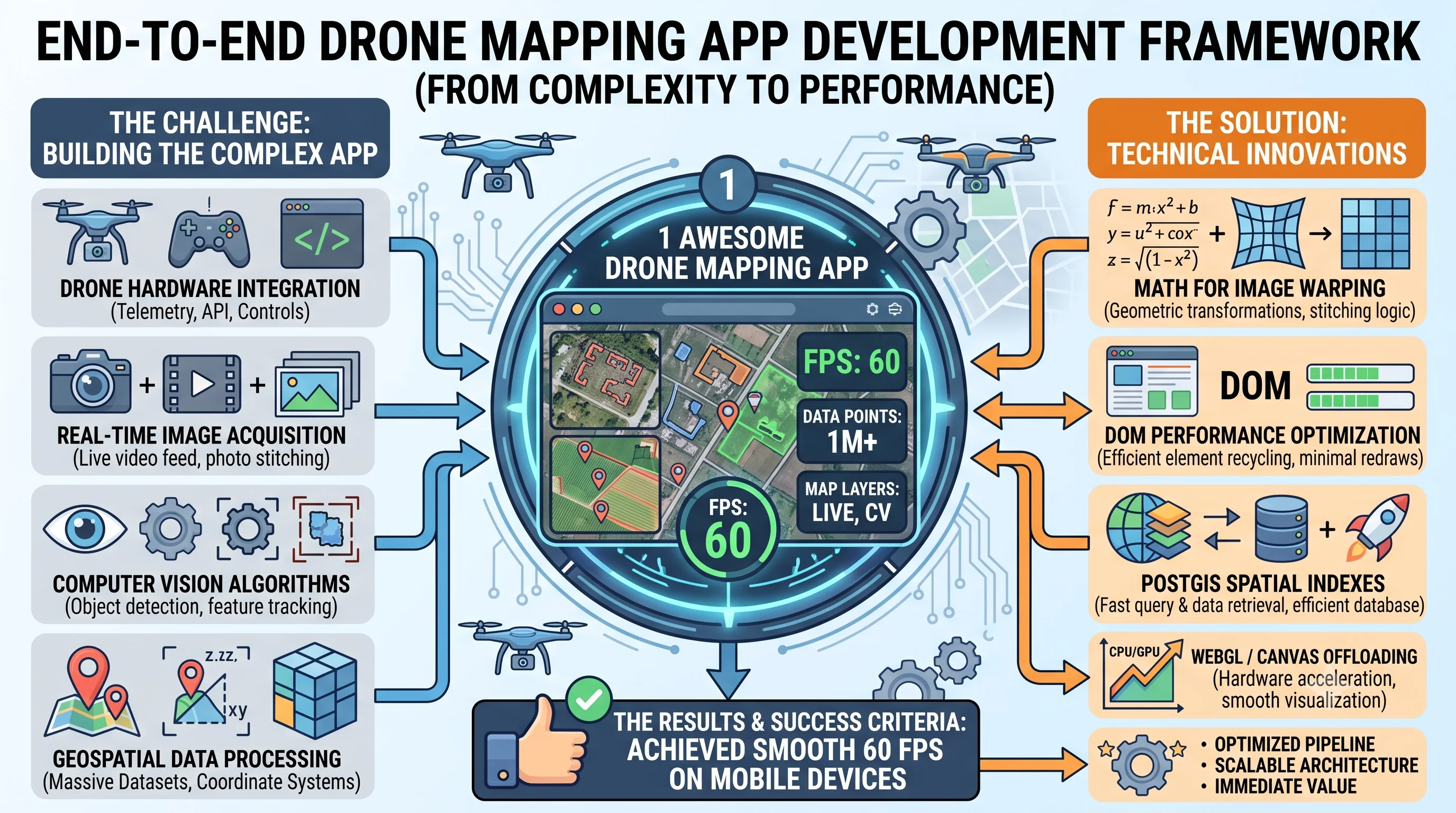
- Set Up the Problem: Explain the scale or technical challenge (e.g., real-time mapping, hardware integration, massive dataset rendering).
- Break Down the Bottlenecks: Discuss the specific engineering friction points (e.g., DOM layout thrashing, slow spatial queries, high latency).
- Detail the Solutions: Highlight advanced concepts or tools you used (e.g., offloading math computations to Canvas/WebGL, indexing spatial data using PostGIS, leveraging web workers).
- Deliver the Metrics: Always conclude with quantifiable results (e.g., "We reduced payload size by 65% and achieved a stable 60 FPS on mobile devices.").
5. "How Do You Ensure Your Applications Are Performant?"
Why They Ask It
Junior developers make things work; senior engineers make things scale. Interviewers want to see a metrics-driven mindset rather than premature optimization based on vibes.
Full-Stack Optimization Checklist to Mention:
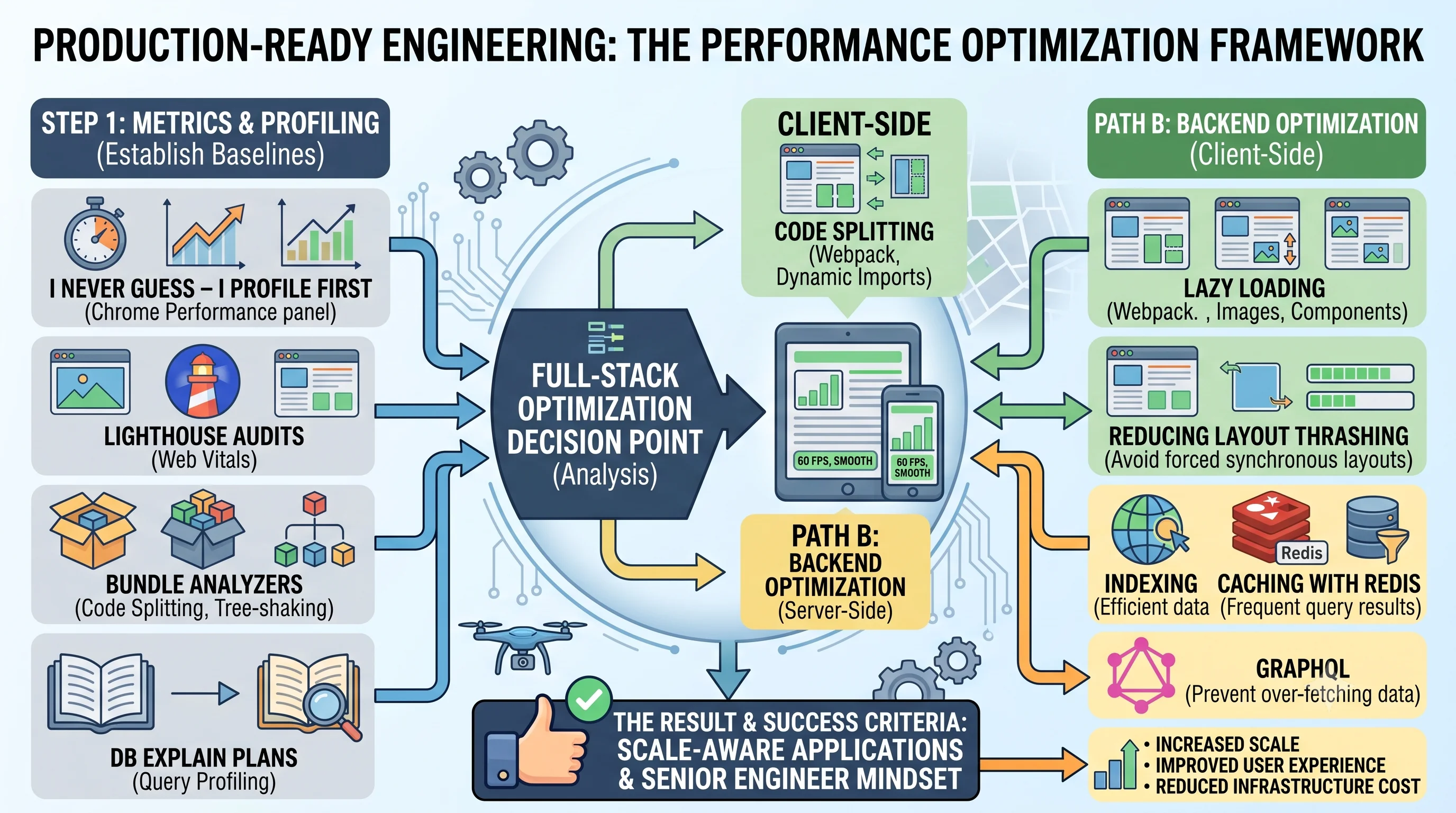
| Stack Layer | Performance Strategy | Key Tools / Tactics |
|---|---|---|
| Frontend | Reduce bundle sizes, prevent layout thrashing | Code splitting, lazy loading, image optimization, bundle analyzers |
| Backend | Efficient data fetching, caching layers | Redis caching, GraphQL batching, asynchronous background jobs |
| Database | Query execution optimization | Indexing, avoiding $N+1$ query issues, analyzing EXPLAIN plans |
| Profiling | Measure before and after changes | Chrome DevTools, Lighthouse, APM tools (Datadog/New Relic) |
Pro-Tip Answer: "I never guess when it comes to performance—I profile first. I establish baseline metrics using tools like Lighthouse and Chrome DevTools, isolate the actual bottlenecks, and systematically optimize from backend query execution down to frontend asset delivery."
The Secret Weapon: The Conversational S.T.A.R. Method

When answering behavioral questions, structure your thoughts using the S.T.A.R. Method:
- S - Situation: Set the context in 1–2 sentences.
- T - Task: State what your responsibility was.
- A - Action: Describe the technical and procedural steps you took.
- R - Result: Share the quantifiable impact or lesson learned.
How to Avoid Sounding Like a Robot
While the S.T.A.R. framework is a industry standard, repeating "The situation was... My task was..." sounds scripted and stiff. Practice weaving these elements together naturally into a storytelling narrative:
"At my last startup, our checkout service hit a massive bottleneck during peak sale events [Situation]. I was tasked with bringing API response times back under 200ms [Task]. I profiled our database calls, identified a classic N+1 query issue, and implemented a Redis caching layer [Action]. As a result, latency dropped by 70%, and we handled record traffic without dropping a single order [Result]."
Bonus: Handling Ambiguous Requirements
If you had to pick a 6th surprise question, it’s this: "What do you do when assigned a task with unclear requirements?"
A junior developer makes assumptions, codes in a bubble for three days, and presents something nobody asked for. A senior developer stops, asks clarifying questions, aligns with product owners, and gets requirements in writing before writing a single line of code.
Next Steps
Interviewing isn't about spouting memorized documentation—it's about demonstrating that you understand the realities of shipping production software in a team environment. Take these 5 questions, write out your own S.T.A.R. responses based on your past experiences, and practice speaking them out loud until they sound natural.
- Watch the Video: https://youtu.be/FKP9WiEQ-sA
- Connect with Me: Follow along on linkedin.com/in/derekscott13 and github.com/huement for more software engineering guides and career advice!


Comments
Add Comment
All Comments
// NO_COMMENTS_IN_BUFFER
Establish initialization protocol by creating the baseline entry trace.
System Moderation Interceptor is ON for this communication hub. All user transmission vectors must clear access protocol filtration approvals before broadcasting logs live to public network arrays.