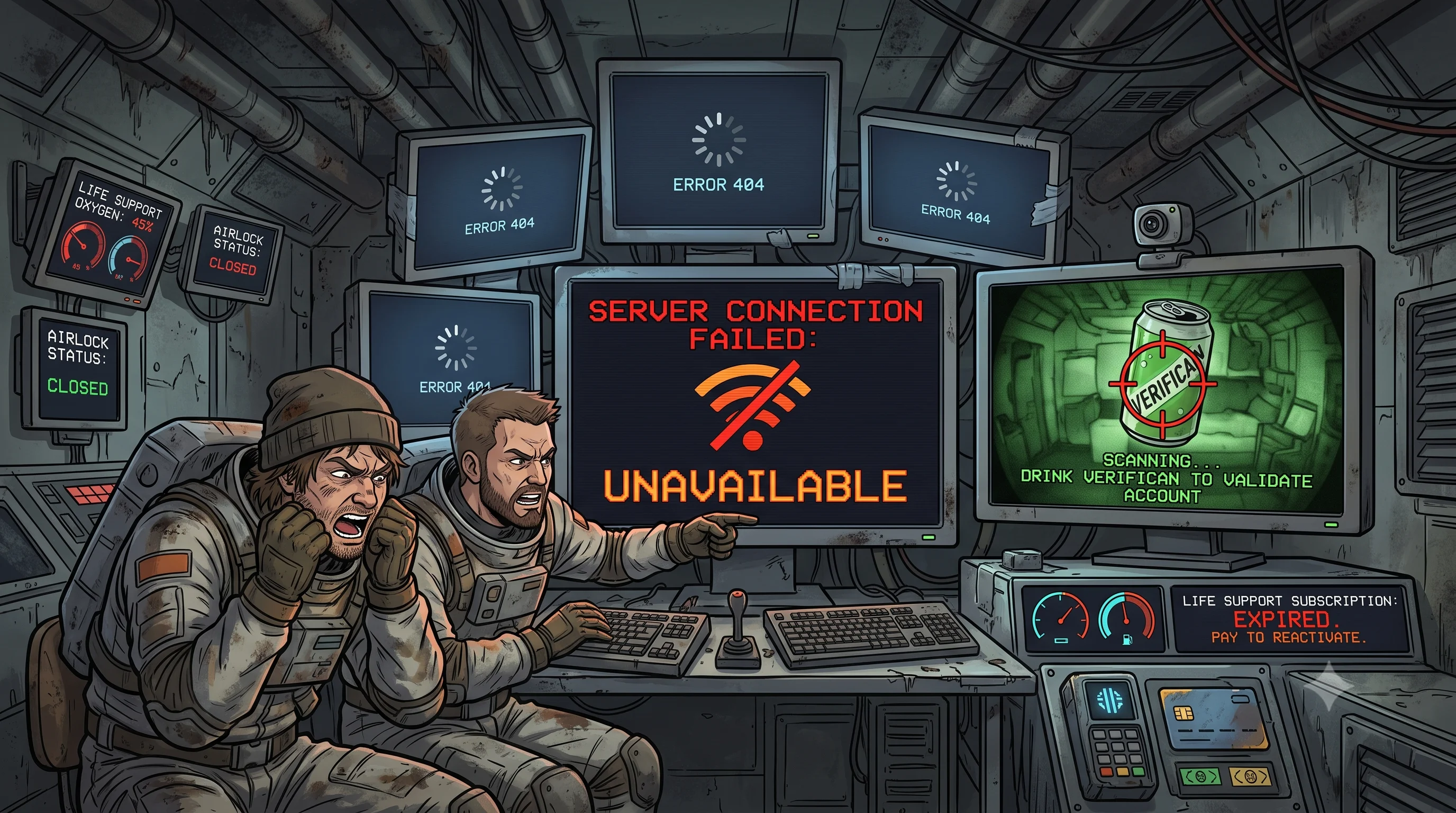
The Death of Physical Media, Corporate Hostility, and the Underground Preservation Revival
1. INTRO: THE 2026 GAMING PARADIGM SHIFT
Picture this: You walk into your local gaming store, excited to pick up the latest blockbuster title on launch day. You remember the midnight launches of years past—lines stretching around the block for Halo 3, The Elder Scrolls V: Skyrim, or Grand Theft Auto V, where hundreds of passionate fans cheered, traded stories, and held tangible boxes in their hands. But when you step through the doors in July 2026, there isn't a single video game disc or cartridge on the shelves. Instead, you are greeted by wall-to-wall displays of Pokémon cards, graded sports slabs, vinyl figures, and rows of digital download cards hanging on plastic pegs.
You leave empty-handed, go home, boot up your current-gen console, and open your digital library—only to find that a game you paid seventy dollars for three years ago has been quietly delisted. Its official servers have been shut down, its online authentication tokens have expired, and your access has been revoked forever. You didn't break any rules; the platform holder simply decided that maintaining the licensing servers was no longer economically viable.
This isn't a hyperbolic, dystopian sci-fi scenario. This is the stark reality of modern gaming in July 2026.
Over the course of a few tumultuous weeks, three massive industry bombshells dropped in rapid succession, laying bare the trajectory of the interactive entertainment business:
- GameStop’s Leadership explicitly declared that physical video game software is now "totally, totally irrelevant" to their retail model as they pivot toward high-margin collectibles and secondary market acquisitions.
- Sony Interactive Entertainment set a definitive execution date for physical media, confirming that starting in January 2028, physical game disc production for all PlayStation titles will be permanently discontinued.
- Nintendo of America found itself locked in a fierce federal court battle, fighting class-action consumer lawsuits over illegal tariff price hikes—demanding millions of dollars in refunds from the U.S. government while telling loyal fans who paid inflated console prices, "You paid for it, deal with it."
When you connect these events, they point to an undeniable conclusion: corporate greed and the forced transition to digital ecosystems are actively killing true software ownership. For decades, purchasing a game meant acquiring a tangible object that you controlled. You could play it offline, lend it to a friend, sell it on the pre-owned market, or store it in an attic for twenty years knowing it would boot up when inserted into operational hardware.
Today, major publishers treat software not as a product, but as a temporary, revocable service. The industry wants you renting access in perpetual subscription loops where storefront monopolies dictate pricing, modify content post-launch, and wipe titles out of existence at will.
However, the fight for game preservation and consumer ownership is far from over. Across the globe, an underground movement of software engineers, open-source maintainers, hardware modders, and preservationists is building tools to bypass corporate kill-switches. From static recompilation projects and emulator milestones to custom-built hardware cartridges that restore physical tactile gaming to digital storefronts, gamers are fighting back.
In this deep dive, we will examine the financial data, corporate maneuvers, and legal battles transforming the industry in 2026 and outline the practical strategies, platforms, and community projects you can use to protect your game library forever.
2. CORPORATE DEEP DIVES: GAMESTOP, SONY, AND NINTENDO
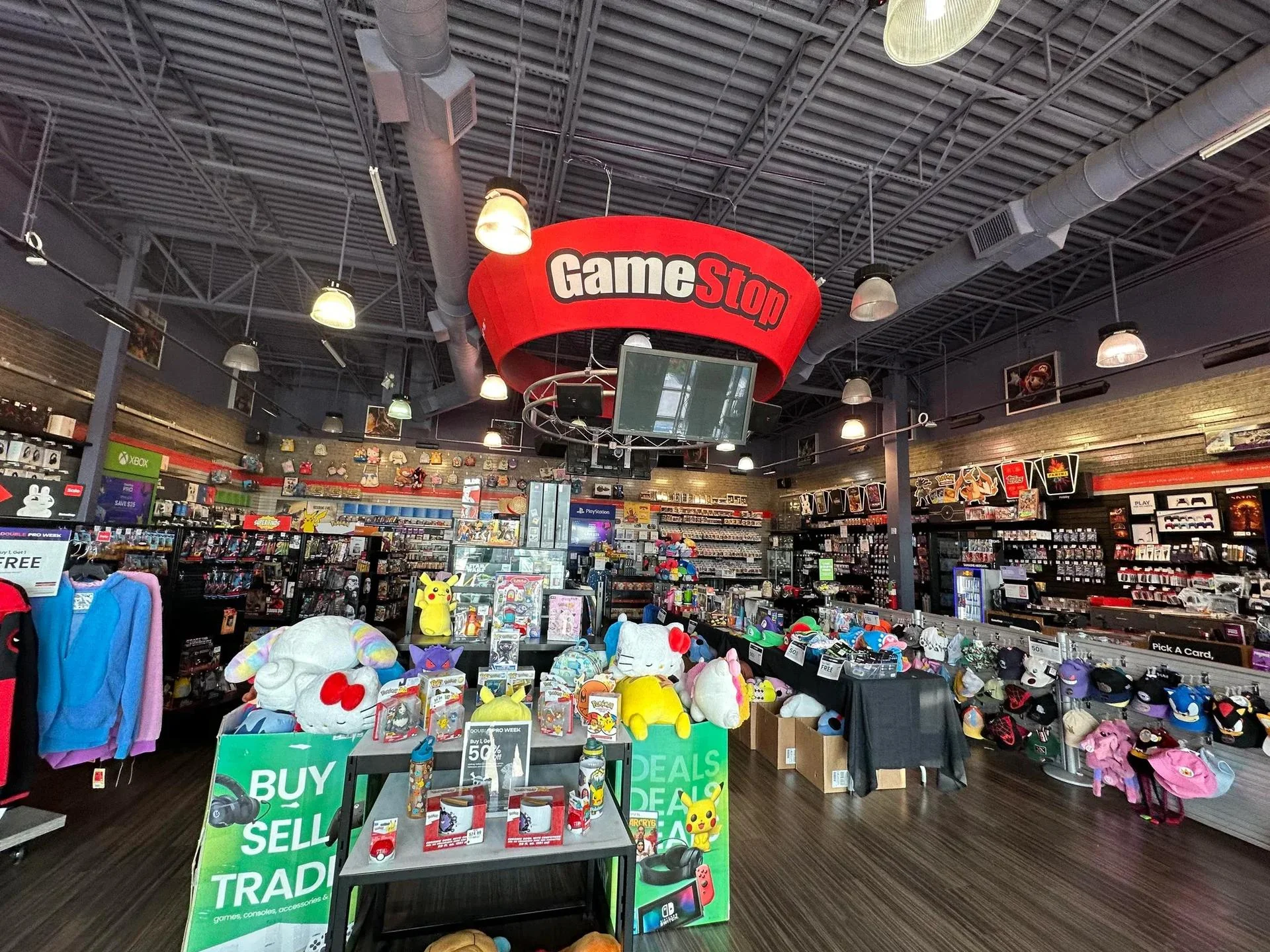
2.1 GameStop: The Death of the Video Game Store & The Collectibles Pivot
For over thirty years, GameStop stood as the physical epicenter of gaming culture. It was the haven where gamers traded in stacks of pre-owned titles to fund their next purchase, argued with store clerks over trade-in values, and gathered for legendary midnight events. But in July 2026, the company's transformation into something entirely different reached its logical conclusion.
During a landmark interview with Bloomberg TV, GameStop CEO Ryan Cohen addressed Sony's upcoming physical disc phaseout and stated the quiet part out loud. When asked how the death of physical software affects GameStop's core retail model, Cohen dismissed physical game sales as "totally, totally irrelevant" to the company’s future.
"It doesn't matter at all... Software today makes up less than 12% of our business. So, it's totally, totally irrelevant." — Ryan Cohen, CEO of GameStop
While hearing the chief executive officer of GameStop claim that video games are irrelevant sent shockwaves through retail communities, the financial reports confirm that Cohen was simply stating cold, hard numbers.
In GameStop’s Q1 2026 earnings report (for the quarter ending May 2026), the company posted its most profitable first quarter in history, generating over $143 million in net profits while maintaining a massive cash war chest of approximately $1.1 billion with almost zero long-term debt. But a granular look at the revenue breakdown reveals where that profit actually came from:
| Revenue Stream | Q1 2026 Revenue | Share of Total Revenue | Year-over-Year Trajectory |
|---|---|---|---|
| Collectibles & Merch | $348.9 Million | 41.8% (Currently >50%) | +65% YoY Increase |
| Hardware & Accessories | ~$333.1 Million | 39.9% | Steady / Minor Decline |
| Software (Physical + Digital) | $152.7 Million | 18.3% (Dropping <12%) | -13% YoY Collapse |
Software sales—which include both physical optical discs, Switch cartridges, and digital download cards combined—collapsed down to a minor fraction of the business. Meanwhile, collectibles (driven heavily by trading cards like Pokémon, PSA-graded cards, apparel, vinyl figures, and GameStop's proprietary Power Packs trading card blind boxes) exploded to over half of all retail revenue.
Why did this pivot occur? Because retail margins on new physical video games are notoriously thin often yielding just $2 to $4 per $70 disc after wholesale costs, shipping, and publisher fees. When factored against store footprint overhead, employee wages, and the shift toward direct digital console storefronts, selling new games became a low-margin hassle.
In contrast, trading cards, pop-culture merchandise, and grading authentication services carry profit margins upwards of 40% to 60%. GameStop stores that once featured floor-to-ceiling rows of pre-owned PS4 and Xbox cases have been systematically remodeled. Floor spaces are now dedicated to trading card displays, plushies, and collectible shelves, while game cases are relegated to a small, hidden rack in the back corner.
Furthermore, Ryan Cohen’s long-term corporate strategy focuses on acquiring secondary online marketplace platforms demonstrated by GameStop's aggressive $56 billion acquisition bid for eBay and its continued accumulation of nearly 8% of eBay stock. GameStop is attempting to leverage its 1,600+ physical locations across America as intake, authentication, and fulfillment hubs for physical collectibles, trading cards, and secondary market goods.
GameStop has survived its decade long retail crisis, but it did so by shedding its identity. It is no longer a video game store; it is a pop-culture hobby shop that happens to carry a few plastic cases on the side. For gamers who relied on retail chains to trade used games, browse physical shelves, or preserve disc-based libraries, the GameStop era is officially over.
Source: https://playfront.de/en/sony-besiegelt-disc-aus-werksumbau-macht-kehrtwende-unmoeglich/
2.2 Sony Interactive Entertainment: The 2028 Physical Media Execution Date
If GameStop’s abandonment of physical software felt like a blow to traditional collectors, Sony’s official policy shift was the knockout strike.
On July 1, 2026, Sid Shuman, Senior Director of First-Party Content at PlayStation, published an update on the official PlayStation Blog that confirmed physical media's end date. Sony announced that starting in January 2028, physical optical disc production for all new video games releasing on PlayStation platforms will be permanently discontinued.
This mandate is not limited to Sony's first-party titles like God of War, Horizon, or The Last of Us. Sony is shuttering its optical disc pressing plants and third-party disc distribution licensing across every single publisher releasing software on PlayStation hardware worldwide.
Starting in 2028, if a gamer walks into a store expecting to buy a physical PlayStation game, they will find only plastic keep-cases containing paper slips printed with digital download codes. Furthermore, internal industry leaks strongly suggest that the upcoming PlayStation 6 console anticipated to launch around late 2028 will not feature an optical disc drive in its baseline hardware configuration, nor will an official add-on drive be manufactured.
Sony justified this decision by highlighting consumer buying patterns, noting that digital downloads currently account for 80% to 85% of all full-game sales on the PlayStation 5 storefront. Sony framed the move as a "natural, eco-friendly evolution" that eliminates manufacturing waste, plastic production, and global shipping logistics.
However, the global gaming community responded with swift outrage. Sony's blog post garnered tens of millions of views and hundreds of thousands of angry replies across social platforms. Advocacy groups, game preservation organizations, and trade associations spoke out. The Entertainment Retailers Association (ERA) in the UK issued a statement criticizing Sony, calling the total elimination of discs "a triumph of corporate convenience over consumer choice and long-term preservation."
Industry veterans quickly pointed out the deep irony of Sony’s move. In 2013, during the infamous Xbox One reveal where Microsoft attempted to restrict used games and require always-online check-ins, Sony won the console generation with its famous 22-second E3 video titled "How to Share Games on PS4," where Shuhei Yoshida simply handed a disc to Scott Rohde. Fifteen years later, Sony is implementing the exact same digital lock-in they once mocked except worse, as disc media is being eradicated entirely.
- 2013 Sony E3 Campaign: "Step 1: Hand the physical PS4 disc to your friend. Done!"
- 2026 Sony Policy Shift: "Step 1: Disc manufacturing ceases. Step 2: Digital Store Monopoly."
In response to the announcement, physical media advocate Jade Pearce of Canadian retailer PNP Games spearheaded the "Don't Kill the Disc" campaign on Change.org. The petition rapidly surged past 300,000 verified signatures, uniting collectors, privacy advocates, and low-bandwidth rural gamers under a shared mission. The petition outlines the core benefits of physical media that digital storefronts strip away:
- True Ownership: Physical discs cannot be retroactively altered, delisted, or revoked due to corporate licensing expirations.
- The Secondary Market: Discs allow players to buy used games at steep discounts, trade with friends, or sell completed games to recoup costs.
- Preservation & Accessibility: Offline access guarantees that games remain playable decades into the future without relying on active authentication servers.
Despite the groundswell of consumer protest, industry analysts agree that Sony is unlikely to reverse course. Sony has already begun re-tooling its optical manufacturing plants into semiconductor and sensor assembly lines.
Digital distribution offers Sony massive financial incentives: zero manufacturing costs, zero freight expenses, no retailer cuts, and the complete destruction of the used game market. By controlling a 100% digital storefront ecosystem on PS5 and PS6, Sony can enforce price points, eliminate pre-owned competition, and dictate digital licensing terms without challenge.
How Gamers Can Express Displeasure and Take Action Right Now:
- Sign and Share Petitions: Participate in organized advocacy campaigns like the "Don't Kill the Disc" petition on Change.org to demonstrate market demand for physical formats.
- Vote With Your Wallet: Refuse to pre-order $70 digital-only titles. Allocate gaming budgets toward DRM-free PC platforms, independent physical release publishers, and studios that prioritize offline playability.
- Cancel Subscription Tiers: Reduce reliance on premium cloud services like PS Plus Premium or Xbox Game Pass, redirecting those recurring funds toward physical copies or permanent DRM-free purchases.
- Lobby for Consumer Legislation: Support legislative initiatives in the European Union and the United States aimed at enforcing right-to-repair laws and mandating clear legal disclosures that digital purchases represent temporary licenses rather than permanent property.
_Source: https://gonintendo.com/contents/60107-gamers-are-suing-nintendo-over-tariff-refunds-update
2.3 Nintendo: The Tariff Double-Dip Scandal & The Legal Battle
While GameStop abandons games and Sony phase out discs, Nintendo has generated backlash through legal disputes over pricing, tariffs, and consumer refunds.
The controversy dates back to mid-2025, when the U.S. government enacted broad reciprocal tariffs on foreign electronics, components, and hardware imports. Facing elevated costs to import consoles manufactured across Asia into the North American market, Nintendo passed these expenses directly onto consumers.
In mid-2025, Nintendo implemented sweeping price increases across its entire hardware lineup:
- Switch Lite: Price increased by +$30
- Standard Switch: Price increased by +$40
- Switch OLED Model: Price increased by +$50
- First-Party Accessories (Pro Controllers, Joy-Cons): Increased by +$5 to +$10
Nintendo publicly justified these price hikes by explicitly pointing to "unprecedented import tariffs, customs duties, and supply chain inflation." Consumers paid the higher prices to acquire hardware.
Then came February 2026. In a landmark 6-3 decision, the Supreme Court of the United States ruled that the 2025 emergency import tariffs were unconstitutional and illegal. The ruling declared that the executive branch overstepped its statutory authority under the International Emergency Economic Powers Act. As a consequence of the tariffs being struck down, the federal government created a $166 billion refund pool to return unlawfully collected tariff duties to importing corporations.
In March 2026, Nintendo of America filed a lawsuit against the United States government in the U.S. Court of International Trade, demanding a full refund of every dollar it paid in tariffs, plus interest.
This action created an ethical and legal conflict: Nintendo had offset its tariff expenses by raising retail prices on consumers. If Nintendo collects a full tariff refund from the U.S. government while keeping the inflated purchase prices paid by consumers, the company effectively profits twice on the exact same hardware.
The Double-Dip Economic Loop:
Gamer buys Switch OLED at +$50 price hike -> Money goes to Nintendo.
Nintendo pays temporary tariff to Customs -> Expenses offset by consumer money.
Supreme Court strikes down tariff -> Government refunds tariff back to Nintendo.
Final Result: Nintendo retains consumer price hike PLUS receives government rebate.
In April 2026, two affected consumers—Gregory Hoffert and Prashant Sharan—filed a class-action lawsuit (Hoffert et al v. Nintendo of America) in federal court. The lawsuit alleges unjust enrichment, arguing that any tariff refunds granted by the government morally and legally belong to the consumers who funded those payments.
On July 21, 2026, Nintendo’s legal team filed a formal motion to dismiss the consumer class-action lawsuit. Nintendo’s legal defense rejected the claim that consumers are owed rebates:
"Those who bought Nintendo’s products received exactly what they bargained and paid for: a console, game and/or accessory at a price to which both parties agreed. Plaintiffs are not entitled to a rebate simply because of intervening legal developments related to tariffs." — Nintendo of America Legal Motion to Dismiss (July 21, 2026)
Nintendo further argued that no legal statutory duty exists requiring a manufacturer to retroactively adjust retail prices on completed sales, and that the company had absorbed "unspecified internal supply chain fluctuations" during the same period.
While Nintendo’s position represents standard corporate defense strategy, the public relations impact has been severe. The optics of a multi-billion-dollar gaming giant suing the government for billions in refunds while telling its own community "you agreed to the price, go away" has reinforced perception of corporate detachment.
3. SUMMARY OF INFERENCES: THE COMMON THROUGH-LINE OF CUSTOMER HOSTILITY
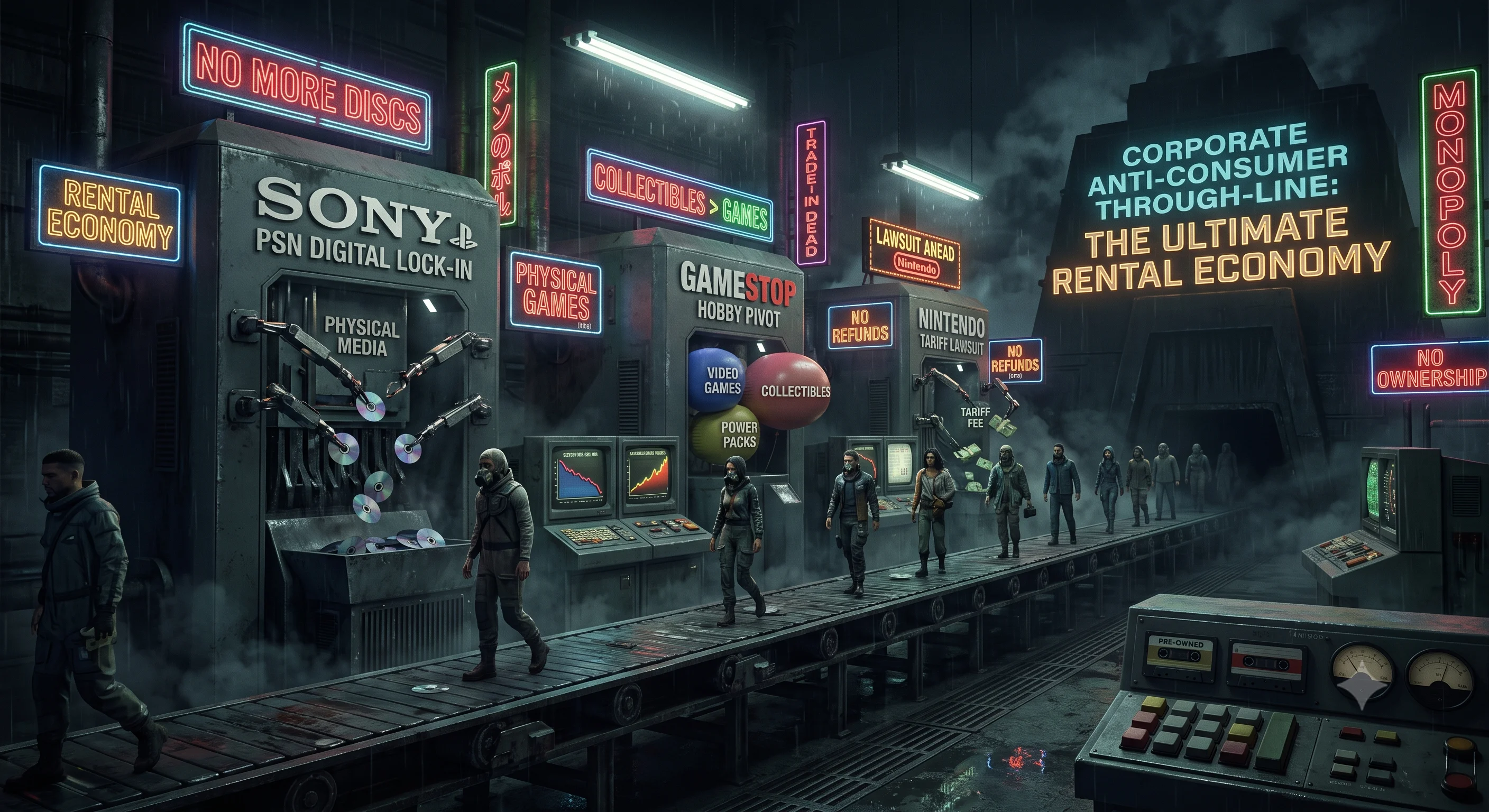
When viewed in isolation, GameStop's retail pivot, Sony's disc phaseout, and Nintendo's tariff lawsuit might appear to be disconnected corporate decisions driven by separate market pressures. However, when analyzed together, an underlying theme emerges: The major players in the video game industry are unified in eroding consumer ownership and extracting maximum value from their user base.
          THE CORPORATE ANTI-OWNERSHIP TRIFECTA
[ GAMESTOP ]          [ SONY INTERACTIVE ]       [ NINTENDO OF AMERICA ]
Abandons game retail to Kills optical disc media Sues government for tariff
focus on high-margin cards to enforce a 100% digital refunds while denying consumer
and secondary markets. storefront monopoly. rebates on marked-up hardware.
\ | /
\ | /
--> COMMON THROUGH-LINE: HOSTILITY TO OWNERSHIP <--
- Elimination of Used/Secondary Markets
- Complete Control Over Software Licensing
- Unilateral Pricing Power & Zero Consumer Recourse
The Common Trends Unifying the Industry in 2026:
-
The Eradication of the Secondary Used Market:
By eliminating physical media, publishers shut down the secondary market entirely. On a digital storefront, games cannot be resold, gifted, or traded. This eliminates pre-owned competition, forcing consumers to pay whatever price the platform holder mandates. -
Complete Control Over Software Lifespans:
Digital-only distribution allows platform holders to dictate when a game dies. When licensing agreements expire (such as soundtrack permissions or branded vehicle rights), titles can be scrubbed from digital storefronts without warning. Without physical discs or offline installers, unpreserved games vanish permanently. -
Maximized Profit Extraction via Lock-In:
Whether through subscription models (PS Plus, Game Pass), digital storefront monopolies, or refusal to grant price refunds, corporations prioritize shareholder returns over goodwill. Consumers are transitioned from owners of physical assets to perpetual subscribers renting access to remote servers.
If gamers rely entirely on major console manufacturers and retail chains to preserve the medium, true ownership will cease to exist. Reclaiming control over interactive entertainment requires turning to independent platforms, emulation frameworks, and open-source hardware solutions.
4. WHAT PEOPLE CAN DO IN GENERAL: PLATFORMS, EMULATION, AND HARDWARE INNOVATIONS
4.1 DRM-Free Platforms & Local Physical Backups
The most direct way to maintain ownership of digital software is by supporting storefronts that offer true DRM-free (Digital Rights Management-free) offline installers.
-
GOG.com (Good Old Games):
GOG remains a leader in DRM-free digital distribution. When you purchase a game on GOG, you receive access to standalone offline installer executables. You can download these files, store them on local hard drives or Network-Attached Storage (NAS) devices, and install them on any PC without needing an internet connection, client software, or active server checks. -
itch.io and Independent Developers:
For indie gaming, itch.io provides direct DRM-free file downloads. Many independent creators sell their software directly via their own storefronts, distributing clean ZIP archives containing game executables that can be preserved indefinitely. -
The 3-2-1 Media Preservation Strategy:
To guarantee your digital library survives hardware failure, employ standard data preservation protocols:- Store 3 copies of your DRM-free game installers.
- Keep them across 2 different media types (e.g., local NVMe SSDs and external cold-storage HDDs).
- Maintain 1 backup in an offsite location or secure encrypted cloud storage.
-
Front-End Organizers (Playnite & LaunchBox):
Open-source application managers like Playnite and LaunchBox allow players to aggregate DRM-free titles, physical disc rips, and emulation roms into a unified, console-like user interface. This creates a completely self-hosted, offline equivalent to Steam or PlayStation Network that operates independent of external servers.
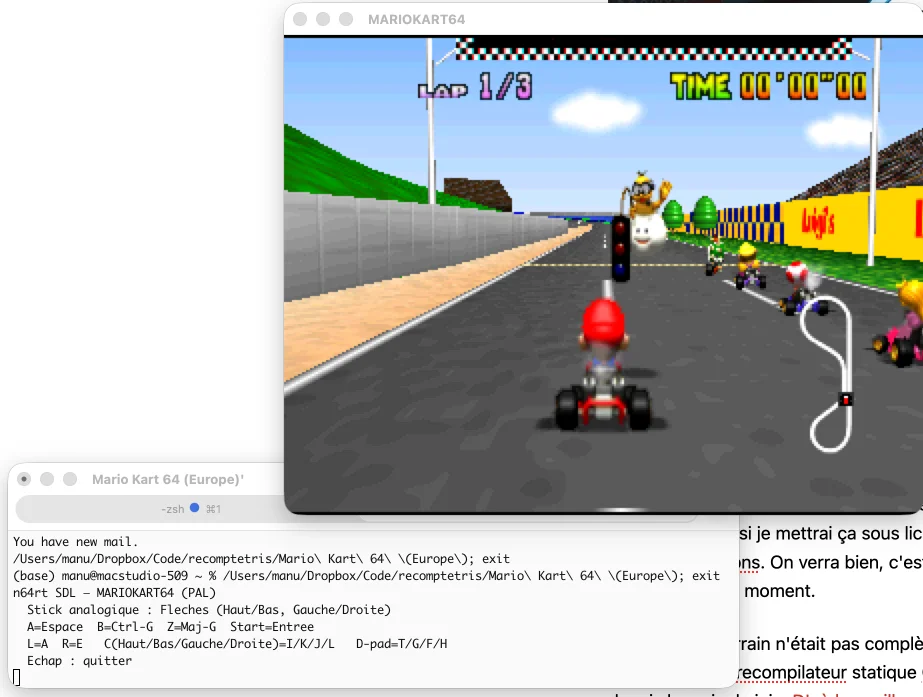
_SOURCE: https://korben.info/en/mario-kart-wii-static-recompilation-pc-native.html
4.2 Software Emulation, Static Recompilation, & The Mario Kart Wii Debate
While DRM-free platforms protect modern PC titles, preserving legacy console software requires emulation and static recompilation.
The RPCS3 Preservation Milestone
A recent victory in software preservation comes from the open-source RPCS3 project (the premier PlayStation 3 emulator). In mid-2026, the RPCS3 development team announced that over 75% of the entire PS3 library (2,681 out of 3,559 cataloged commercial games) is now classified as fully "Playable" from start to finish without progression-blocking bugs.
This milestone arrives ahead of Sony's planned total shutdown of the legacy PS3 and PS Vita storefronts by July 2027. When Sony flips the switch on those servers, RPCS3 will remain one of the few functional methods to run PS3 classics natively on modern hardware at 4K resolutions and 60+ FPS.
Emulation vs. Static Recompilation
Traditional emulation (such as Dolphin or PCSX2) works by interpreting original console machine code instruction-by-instruction on the fly, translating it into host PC instructions. While highly accurate, interpretation requires heavy CPU processing overhead.
Static Recompilation takes a different path. Recompilation tools analyze an entire console game binary ISO file and translate its machine code directly into standard PC C++ or x86 assembly before execution. The resulting output compiles into a native, standalone PC application (.exe) that runs without emulator overhead, delivering locked performance, lower input latency, and native 4K scaling.
TRADITIONAL EMULATION:
[Console ISO] --> [Interpreter Engine (High Overhead)] --> [Host CPU Execution]
STATIC RECOMPILATION:
[Console ISO] --> [Recompiler Utility] --> [Native C++ Code] --> [Native PC .EXE]
The Mario Kart Wiicompiled Project & The "Vibe Coding" Controversy
In July 2026, developer Patchzyy (creator of the Wheel Wizard manager for Retro Rewind) revealed Mario Kart Wiicompiled—the first-ever static recompilation of a full Nintendo Wii software binary for native Windows execution.
Targeting an August 2026 public beta, the project runs as a native PC app featuring built-in support for Retro Rewind (a community mod adding over 200 custom and retro tracks), online play, native 4K rendering support, and unlocked frame rates. To avoid legal takedowns, the software contains zero proprietary Nintendo artwork, audio, or assets; users must supply their own legally dumped Mario Kart Wii ISO file to build the native executable.
However, the project sparked immediate debate across the developer community regarding its underlying codebase.
Patchzyy revealed that significant portions of the recompilation code were generated using Large Language Model (LLM) coding tools—a practice known colloquially in dev circles as "vibe coding." This split community reaction between those praising the speed of development and software engineers warning of long-term maintainability traps.
MARIO KART WIICOMPILED: THE COMMUNITY DIVIDE
PROS / INNOVATIVE FEATS CONS / SECURITY RISKS
Native PC performance & 4K support. - LLM code maintainability traps.
Direct Retro Rewind integration. - Physics locked to 60 FPS engine.
Zero copyrighted assets included. - Unsandboxed PC RCE Vulnerabilities!
Beyond code structure, security researchers raised a serious issue: Remote Code Execution (RCE) risks.
Mario Kart Wii’s original online netcode contains known, unpatched buffer overflow and memory corruption vulnerabilities. When running inside traditional emulators like Dolphin, the emulator acts as a sandboxed virtual environment. If an attacker exploits a netcode vulnerability in Dolphin, the exploit is generally contained within the emulator sandbox.
However, a statically recompiled game runs as a native Windows application with direct memory access and host system privileges. If an AI-assisted recompilation port retains legacy Wii netcode bugs, an attacker exploiting an RCE vulnerability on an online server wouldn't just crash a virtual Wii—they could gain unauthorized access to the host PC's operating system, personal files, and credentials.
Recommended Alternatives & Official Links:
Due to these considerations, community maintainers recommend exercising caution with early AI-assisted recompilation builds until security audits are completed. For stable, sandboxed multiplayer gaming, players can use established tools:
- Dolphin Emulator: The gold standard for sandboxed, secure GameCube and Wii emulation across modern platforms.
- Wheel Wizard Launcher: The official launcher for managing Retro Rewind track packs and online matchmaking safely via Dolphin.
- Wheel Wizard GitHub Repository: TeamWheelWizard / WheelWizard on GitHub
- Wheel Wizard / Wiicomp Community Discord: Join the Official Discord Server

SOURCE: https://bsky.app/profile/princessmidori.bsky.social/post/3mqs2j4opzc22
4.3 Hardware Innovations: Turning Digital Steam Libraries into SATA SSD Cartridges
While software recompilation preserves legacy games, hardware enthusiasts are finding ways to bring physical tangible media to modern digital libraries.
One of the most creative community projects in 2026 comes from PC builder and modder Jibril-sama (also known as PrincessMidori). Frustrated by the intangible nature of modern Steam libraries, Jibril-sama designed a custom SATA SSD Cartridge System that turns digital PC games into physical swap cartridges.
How the System Works:
- Hardware Casing: Low-cost 2.5-inch SATA Solid-State Drives (128GB to 512GB) are enclosed inside custom 3D-printed plastic cartridge shells featuring full-color custom box art labels.
- Hot-Swap Bay: A standard 2.5-inch hot-swappable SATA drive dock is mounted into the front optical drive bay of a desktop PC chassis.
- Automated Linux Scripting: When an SSD cartridge is inserted into the dock, custom background system scripts detect the drive, mount the partition, launch Steam, and automatically execute the specific game assigned to that cartridge.
                      SATA SSD CARTRIDGE PIPELINE
[Insert Cartridge] --> [Hot-Swap SATA Dock] --> [Linux udev Event Triggered]
		|
		v
[Steam Launches App ID] <-- [Read game_id.txt] <-- [Auto-Mount Drive Partition]
The Automated Shell Scripts:
This setup relies on automated udev rules and systemd service triggers within Linux / SteamOS desktop environments. Below are the actual configuration scripts used to build an automated SSD cartridge system:
File 1: /etc/udev/rules.d/99-game-cartridge.rules
# Detect insertion of SATA drive partition labeled "Cartridge_*" and trigger launch script
KERNEL=="sd[a-z]1", SUBSYSTEM=="block", ENV{ID_FS_LABEL}=="Cartridge_*", ACTION=="add", RUN+="/usr/local/bin/launch_cartridge.sh %E{ID_FS_LABEL}"
File 2: /usr/local/bin/launch_cartridge.sh
#!/bin/bash
# Automate mounting, Steam identification, and software execution
CART_LABEL="$1"
MOUNT_POINT="/media/cartridges/${CART_LABEL}"
Step 1: Create mount point directory and mount filesystem
mkdir -p "${MOUNT_POINT}"
mount "/dev/disk/by-label/${CART_LABEL}" "${MOUNT_POINT}"
Step 2: Read unique Steam App ID from root text configuration file
IFILE="${MOUNT_POINT}/game_id.txt"
if [ -f "$IFILE" ]; then
APP_ID=$(cat "$IFILE")
Step 3: Set display environment variables and launch game via Steam URL handler
export DISPLAY=:0
export XAUTHORITY=/home/user/.Xauthority
steam "steam://rungameid/${APP_ID}"

fi
This DIY hardware innovation deserves immense credit. It bridges retro physical media handling with modern PC gaming performance. Games remain off the OS drive, saving internal storage while restoring the tactile experience of selecting a game off a shelf and inserting it into hardware to play.
It stands as a testament to what makes the gaming community resilient: when giant corporations attempt to strip away physical media, passionate players will build it themselves.
5. CONCLUSION: THE ACTION PLAN FOR GAMERS IN 2026
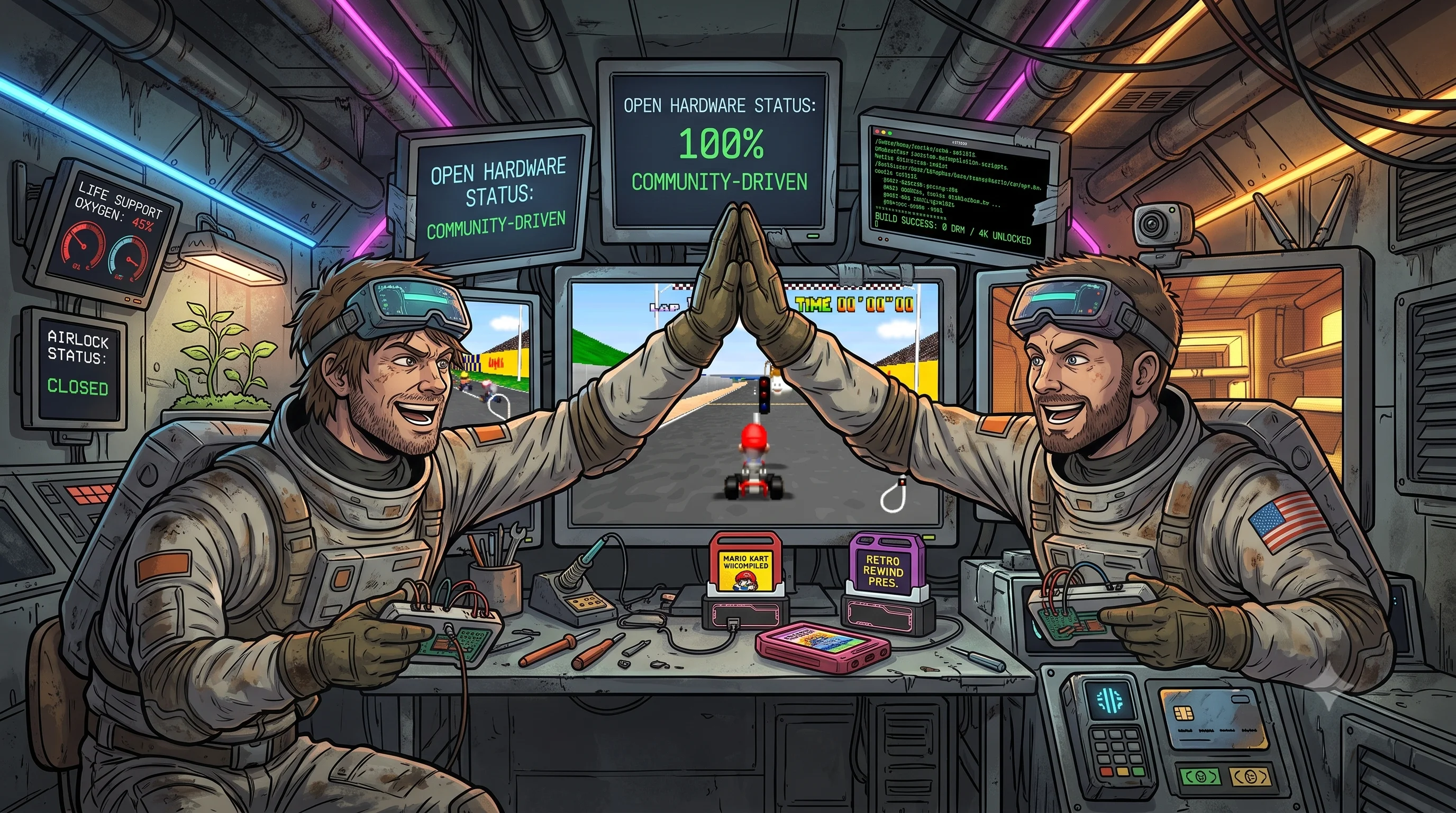
The interactive entertainment industry stands at a critical juncture in 2026. The major corporate platform holders have made their vision of the future clear: an all-digital ecosystem controlled by storefront monopolies, where physical media is phased out, pricing is strictly enforced, and true software ownership is replaced by temporary licenses.
GameStop is pivoting to collectibles. Sony is discontinuing physical discs. Nintendo is fighting in court to keep government tariff refunds while denying rebates to consumers.
Yet, as corporate control tightens, the tools to maintain independence are more accessible than ever. By combining DRM-free digital platforms, local data redundancy, open-source emulation, and creative hardware modding, gamers can ensure that their collections remain intact forever.
Your Action Checklist to Protect Your Games Today:
- Audit Your Current Library: Identify titles in your collection that rely on online server checks or always-online DRM. Where possible, acquire DRM-free installer backups or physical copies.
- Support DRM-Free Retailers: Prioritize buying PC games from GOG.com, itch.io, and direct developer sites. Download offline setup files and store them on local drives using the 3-2-1 backup rule.
- Preserve Your Physical Discs: Maintain your physical current-gen and retro game discs. Consider dumping your physical media into clean ISO/ROM backups for personal use on software emulators like Dolphin and RPCS3.
- Participate in Advocacy: Sign petitions like "Don't Kill the Disc," support organizations like the Video Game History Foundation, and push for consumer protection legislation governing digital storefront licensing.
- Support Community Developers: Back open-source emulator developers, preservation teams, and independent hardware modders who build open tools for the community.
Video games are art, culture, and history. They should not exist at the temporary whim of corporate boardrooms or authentication servers. Protect your games, preserve your hardware, and hold the line for true ownership.


Comments
Add Comment
All Comments
// NO_COMMENTS_IN_BUFFER
Establish initialization protocol by creating the baseline entry trace.
System Moderation Interceptor is ON for this communication hub. All user transmission vectors must clear access protocol filtration approvals before broadcasting logs live to public network arrays.